
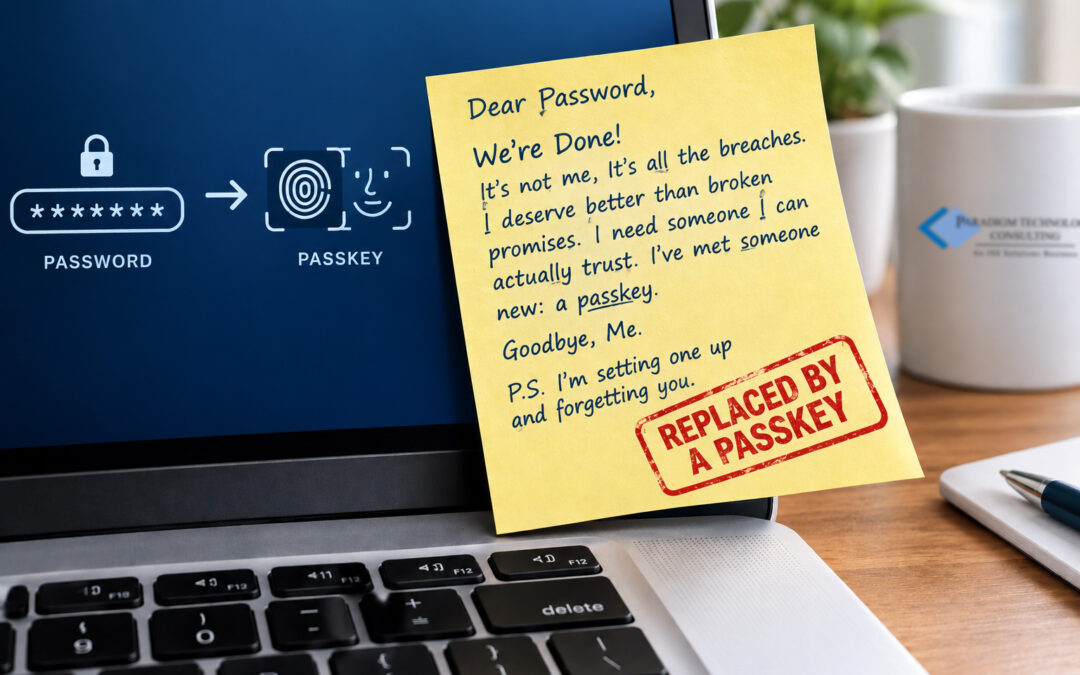
For decades, passwords have been the first line of defense for our online accounts. But passwords are also one of the biggest security weaknesses organizations face.
Weak passwords, reused credentials, phishing attacks, credential theft, and password-based breaches continue to put businesses at risk. As cyber threats become more sophisticated, organizations are looking for a better way to protect accounts without relying on users to create, remember, and regularly change complicated passwords.
Enter passkeys.
What Is a Passkey?
A passkey is a modern, passwordless way to sign in to websites, applications, and services.
Instead of entering a password, users authenticate using something already built into their device, such as:
- A fingerprint
- Facial recognition
- A PIN or device passcode
- A security key
Behind the scenes, passkeys use public-key cryptography. A unique cryptographic key pair is created for the account. The private key stays securely on the user’s device, while the corresponding public key is used by the service to verify the user’s identity.
The result? There is no password for an attacker to steal, guess, or trick a user into revealing.
Why Are Passkeys More Secure?
One of the biggest advantages of passkeys is their resistance to phishing.
With a traditional password, an attacker can create a convincing fake login page and trick someone into entering their credentials. With a passkey, the authentication process is tied to the legitimate website or service, making it significantly more difficult for a user to unknowingly give their authentication credentials to a cybercriminal.
Passkeys also eliminate many of the problems associated with passwords:
No password reuse.
Users don’t have to create a different password for every account.
No password resets.
Forgotten passwords become far less of an issue.
No passwords stored on servers.
Services don’t need to store traditional passwords that could potentially be exposed in a data breach.
Better protection against phishing.
Passkeys are designed to work only with the legitimate service they were created for.
Passkeys Don’t Just Improve Security—They Improve the User Experience
Security controls can sometimes create frustration for employees. Complex password requirements, frequent resets, password managers, and multi-factor authentication prompts can make logging in feel like a chore.
Passkeys can simplify the process.
For many users, signing in can be as easy as looking at their device, using their fingerprint, or entering a device PIN.
That combination of stronger security and a simpler login experience is one of the reasons passkeys are gaining momentum.
Are Passwords Going Away Completely?
Not yet.
Many organizations and applications still rely on traditional passwords, and businesses will likely operate in a mixed authentication environment for some time.
However, passkeys are becoming increasingly available across major operating systems, browsers, applications, and cloud services. Organizations should begin evaluating where passwordless authentication can make sense within their security strategy.
Passkeys can also complement other security controls, including multi-factor authentication (MFA), identity and access management, conditional access, and endpoint security.
What Should Businesses Do Now?
Cybersecurity Awareness Month is a good opportunity to take a closer look at how your organization manages authentication.
Consider these questions:
- Which of our systems still rely heavily on passwords?
- Are employees reusing passwords across applications?
- Where can we enable passkeys or other passwordless authentication options?
- Are MFA and conditional access policies properly configured?
- Which accounts have elevated privileges?
- How are former employees’ accounts and access being handled?
- Do we have a plan for strengthening authentication across our most critical systems?
You don’t have to eliminate passwords overnight.
Start with your highest-risk accounts and applications. Evaluate the authentication options available and develop a roadmap for moving toward stronger, phishing-resistant authentication.
The Future of Authentication Is Changing
Passwords have been around for a long time, but they don’t have to be the future of cybersecurity.
Passkeys offer organizations a way to strengthen authentication while making the sign-in experience easier for users. As more applications and platforms adopt passkey technology, businesses have an opportunity to reduce their reliance on passwords and improve their overall security posture.
The question isn’t just whether your passwords are strong enough. It’s whether you still need passwords at all.
Need Help Strengthening Your Cybersecurity?
Paradigm Technology Consulting can help your organization evaluate authentication, cybersecurity, infrastructure, and other technology risks—and develop practical solutions to improve your security posture.
Contact PTC at sales@ptcsolutions.com to discuss your cybersecurity needs.